How to Choose a Marketplace Business Model
Directory, lead gen, booking, and managed marketplaces are different choices about control, liability, monetization, and who owns the transaction.
Founders talk about "building a marketplace" as if that describes one business model. It does not.
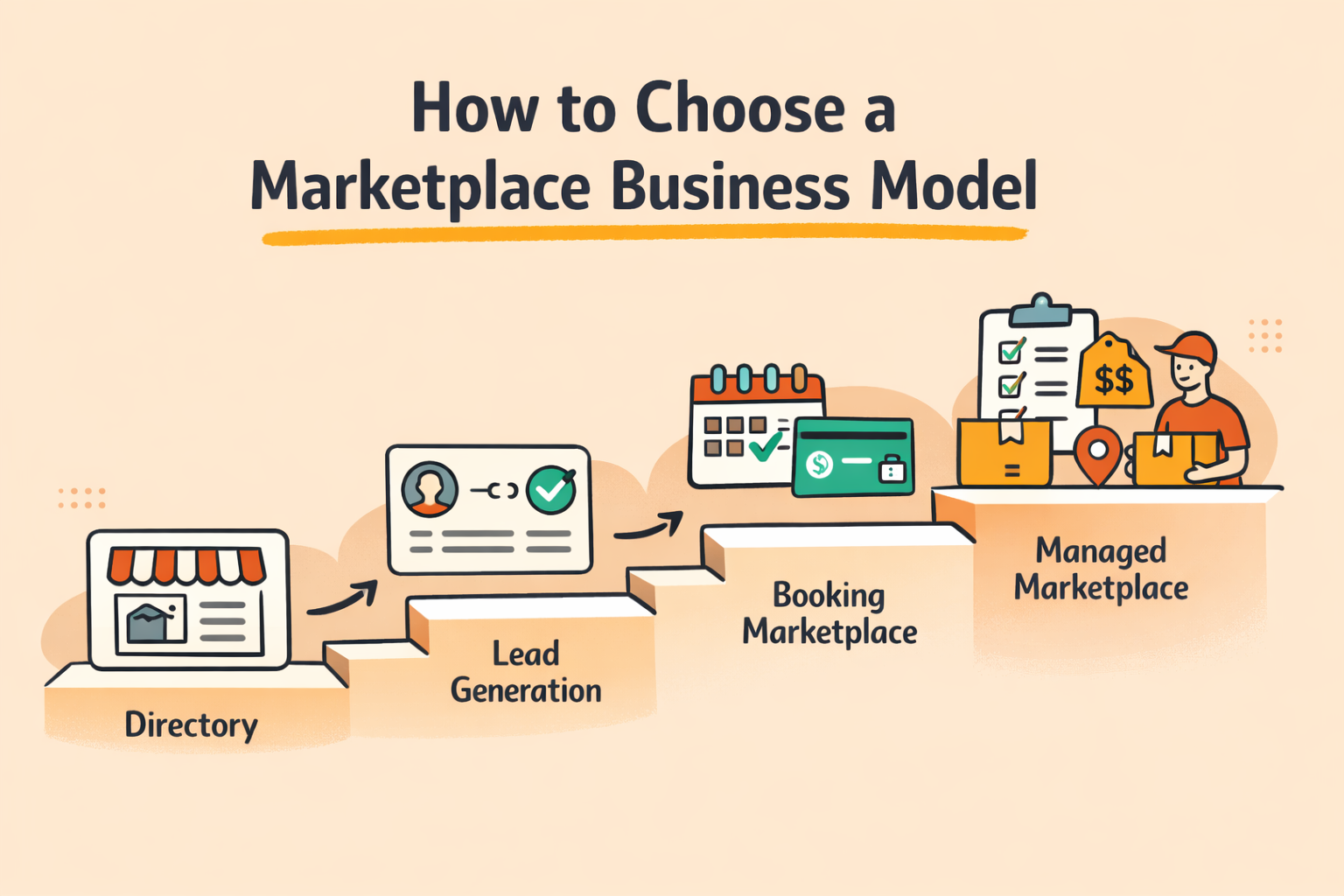
What they usually mean is one of four very different businesses:
- a directory that sells visibility
- a lead generation engine that sells results
- a booking marketplace that owns payment but not the outcome
- a managed marketplace that owns pricing, assignment, operations, and blame
That difference matters more than most people think.
The mistake I see most often is teams jumping straight to the most complex version because it feels the most ambitious. In practice, the right decision is usually much simpler: start with the lightest model your vertical allows, then move up the stack only when traffic, trust, and operational leverage justify it.
This is the lens behind the Marketplace Business Model Comparison tool. The real question is not whether you are building a marketplace. The real question is how much of discovery, matching, payment, and liability you want to own.
In This Article
- How the Matrix Actually Works
- The Four Marketplace Models
- The Two Splits That Matter Most
- The Marketplace Business Model Comparison Tool
- How the Transaction, Money Flow, and Liability Change by Level
- How to Read the Matrix Criteria Properly
- Level 1: Directory / Listings
- Level 2: Lead Generation
- Level 3: Booking Marketplace
- Level 4: Managed Marketplace
- The Pattern Behind the Best Marketplace Businesses
- How Traffic Strategy Changes by Level
- How to Drive Traffic From ChatGPT, Google AI, and Other Answer Engines
- How to Use TikTok, Instagram, LinkedIn, YouTube, and Other Platforms
- How I Would Decide Which Level to Build
- What I Would Do in 2026
- Sources
How the Matrix Actually Works
The matrix is not just a list of four marketplace categories. It is a control map.
It compares each model across the things that actually change the business:
- who pays you
- who sets price
- who picks the provider
- what percentage of the transaction stays on-platform
- how hard it is to get disintermediated
- how much ops burden you take on
- how much capital you need
- what payment infrastructure you need
- what kind of legal and trust liability you are accepting
That is why the matrix matters. It forces you to stop thinking in vague product language and start thinking in operating-model language.
The tool also makes something else obvious: these levels are not just product maturity stages. They are different economic systems.
Level 1 monetizes attention.
Level 2 monetizes intent.
Level 3 monetizes transactions.
Level 4 monetizes fulfillment quality and control.
That is a much better way to think about marketplace models than the usual "supply, demand, liquidity" abstraction by itself.
The Four Marketplace Models
The cleanest way to think about marketplace models is as a ladder of control.
At Level 1, the platform mostly controls discovery.
At Level 2, the platform controls discovery plus matching.
At Level 3, the platform controls discovery, booking, and payment.
At Level 4, the platform controls nearly everything except the physical delivery of the service itself.
That is why these models should not be treated as branding choices. They are operating-model choices. Each level changes:
- who pays you
- when you get paid
- what you have to build
- how easy it is to get disintermediated
- how much trust and support infrastructure you need
- how much legal and operational liability you take on
Here is the compact version:
| Level | Model | Who pays the platform | What the platform really sells | What stays off-platform |
|---|---|---|---|---|
| 1 | Directory / Listings | Provider via subscription or featured placement | Visibility | Communication, pricing, contracts, payment, delivery |
| 2 | Lead Generation | Provider via lead fee, credits, or subscription | Results | Most of the transaction after the match |
| 3 | Booking Marketplace | Buyer pays on-platform, platform takes a fee | Booking and payment infrastructure | The actual service and most outcome risk |
| 4 | Managed Marketplace | Buyer pays platform, platform pays provider | Fulfillment, reliability, and a platform-backed outcome | Mostly just the physical execution |
The core idea is simple: as you move up the stack, take rate rises, but so do complexity, capital requirements, and blame.
The Two Splits That Matter Most
Most founders get confused because they compare all four levels at once. I think it is easier to separate the decision into two major splits.
1. Pay for visibility vs. pay for results
The first split is between Level 1 and Level 2.
At Level 1, the provider pays for visibility. The deal can close or fail later and you still get paid. That is why directories are the fastest model to launch. You are selling presence, ranking, and attention.
At Level 2, the provider pays for results. That can mean a lead, a contact, a quote request, a click, or a lead unlock via credits. This usually increases monetization, but it also creates constant pressure around lead quality. The provider stops asking, "Do I have a profile?" and starts asking, "Are these leads converting?"
This is a meaningful business-model jump. A directory can survive with strong SEO and enough supply-side willingness to pay for exposure. A lead-gen marketplace has to prove economic value much more directly.
2. Buyer chooses vs. platform assigns
The second split is between Level 3 and Level 4.
At Level 3, the buyer chooses the provider. The platform helps discovery, booking, payments, and reviews, but the buyer still owns the final selection. That matters because it limits liability. If the experience goes wrong, the platform can still say, "You chose them."
At Level 4, the platform assigns the provider, sets price algorithmically, and usually makes some kind of reliability promise. That changes everything. The platform is no longer just facilitating. It is now responsible for matching quality, service consistency, recourse, and operational failure.
The easiest way to test this split is what I call the blame test:
- Level 1: "We just list them."
- Level 2: "We just matched you."
- Level 3: "You chose them."
- Level 4: "We assigned them."
That last sentence is where the real operational burden begins.
The Marketplace Business Model Comparison Tool
The tool below is the interactive version of this framework. It compares the four levels side by side across control, liability, build complexity, examples, transaction flow, and decision criteria.
{{< tool "marketplace-matrix" >}}
How the Transaction, Money Flow, and Liability Change by Level
The fastest way to understand the matrix is to follow the transaction.
Level 1 flow
The buyer usually comes in through search, browses profiles, compares providers, and fills out a contact form. The platform forwards that form. Then the deal leaves the platform.
Money flow:
- provider pays the platform a recurring fee
- buyer pays the provider directly
The platform controls discovery, but not the transaction. That is why Level 1 is easy to build and easy to disintermediate.
Level 2 flow
The buyer submits a structured brief. The platform matches that brief to several providers. Providers pay to unlock or receive the lead. Then the deal usually closes off-platform.
Money flow:
- provider pays the platform per lead, per credit, or via subscription
- buyer still pays the provider directly
The platform now controls discovery plus matching. That is a better business than Level 1 if lead quality is real, but it still does not own payment.
Level 3 flow
The provider sets up a profile, services, prices, and availability. The buyer searches, picks a provider, books a slot, and pays on-platform. The platform confirms the booking, handles reminders, and pays out the provider after taking its fee.
Money flow:
- buyer pays the platform
- platform pays the provider minus commission
- optional provider SaaS revenue may sit on top
This is the first point where the platform owns enough workflow to create real lock-in.
Level 4 flow
The buyer submits a request. The platform prices it, collects payment, assigns supply, controls messaging more tightly, tracks the job, and resolves disputes if needed.
Money flow:
- buyer pays the platform up front
- platform holds and releases payment
- platform may also carry guarantee, insurance, or refund exposure
This is the highest-control model. It is also the highest-blame model.
How to Read the Matrix Criteria Properly
The matrix tool compares the levels on criteria that founders often underestimate. Here is the more useful interpretation.
| Criterion | L1 | L2 | L3 | L4 |
|---|---|---|---|---|
| Service value | Any, often high-ticket | Usually mid to high-ticket | Usually low to mid-ticket recurring | Usually lower-ticket, standardized, repeatable |
| Service complexity | High, custom | Medium to high | Medium | Low and standardized |
| Transaction frequency | One-off or infrequent | Occasional | Recurring | High frequency |
| Can price algorithmically? | No | Partially | Sometimes | Yes, usually required |
| Payment infrastructure | Stripe billing | Stripe plus credits | Stripe Connect | Connect plus escrow-like controls and protections |
| Ops burden | Minimal | Low to medium | Medium | Very high |
| Capital required | Lowest | Low | Meaningfully higher | Highest |
| Legal liability | Almost none | Still low | Moderate | High |
This table looks simple, but it is where many marketplace mistakes become obvious.
If your service is custom, high-ticket, and negotiated, forcing it into a managed marketplace usually creates pain. You end up pretending the service is more standardized than it really is.
If your service is low-ticket, frequent, and highly repeatable, staying in a passive directory model often leaves money on the table because the platform is refusing to own the part of the workflow where the value actually compounds.
The matrix also includes time-to-build and revenue-potential guidance:
- Level 1: roughly 2 to 4 weeks to get live; best for speed and recurring subscription revenue
- Level 2: roughly 4 to 8 weeks; stronger revenue per provider, but higher quality pressure
- Level 3: roughly 2 to 4 months; materially better take rates and better retention loops
- Level 4: roughly 4 to 8 months or more; biggest upside, biggest operations bill
That is not a law of nature, but it is directionally right. The farther you move from discovery into execution, the more product becomes operations.
Level 1: Directory / Listings
Level 1 is the best starting point for more verticals than most people realize.
This model works when providers care about visibility, deals are high value or custom, and transactions naturally close offline. Good categories include agencies, legal, consulting, medical specialists, and niche professional services where buyers want to compare options but not necessarily transact on-platform right away.
The matrix points to a simple Level 1 stack:
- Next.js or another fast web framework
- profile and category pages
- Stripe subscriptions
- contact forwarding
- claim-your-listing flow
What you build:
- profile pages
- category and location pages for SEO
- a claim-your-listing flow
- contact forwarding
- subscription billing for premium visibility
What you skip:
- marketplace payments
- scheduling
- dispute systems
- service tracking
The big advantage is speed. You can launch quickly, seed supply from open or public datasets where appropriate, and start monetizing with subscriptions or featured placement before you own the transaction.
The weakness is equally clear. Revenue ceilings show up fast if you do not layer on more value. You are also vulnerable to disintermediation because once a buyer has the provider's details, the platform often disappears from the relationship.
The public examples in the matrix make the point well:
- Psychology Today monetizes professional visibility
- Clutch sells placement and demand capture to agencies
- Avvo and Justia use professional directory visibility as the wedge
- Remote OK shows how simple paid visibility can work even in job-marketplace form
The operator lesson is that Level 1 is often a search-and-structure business before it becomes a marketplace-operations business.
Level 2: Lead Generation
Level 2 is where the platform starts selling outcomes instead of attention.
This is usually the right move when buyer intent is structured enough to capture in a form, providers are willing to pay for demand, and service value is high enough that a lead can be monetized directly. Home services, legal, finance, and some healthcare categories fit well here.
The matrix points to a Level 2 stack that still stays relatively lean:
- everything from Level 1
- structured briefs
- matching logic
- email and SMS delivery
- credit or token billing
- analytics on delivery and response
What you add on top of Level 1:
- structured project briefs
- matching logic
- lead routing
- provider notifications
- credit or per-lead billing
- reporting on response and performance
This is a stronger business than a pure directory when traffic exists because monetization tracks value more directly. Exclusive leads, shared leads, credits, and hybrid subscription models all become possible.
But this is also where complaints start to get louder. Lead quality becomes the core product. If buyers are vague, providers are mismatched, or the lead is over-shared, supply churn rises quickly.
I also think it is important to call out a common trap from the matrix: some products look like booking marketplaces but are really lead gen in disguise. If the booking is just a fancy contact form and payment still happens offline, you are probably still in Level 2 economics.
Representative examples from the matrix include Google Local Services Ads, Bark, HomeAdvisor, Porch, Networx, Modernize, and Thumbtack.
That example set is useful because it shows the real Level 2 game: better qualification, better routing, better supply economics, and constant pressure to prove ROI.
Level 3: Booking Marketplace
Level 3 is the first point where the platform really owns the transaction.
The buyer picks a provider, chooses a slot or package, books on-platform, and pays through the marketplace. That shift does two important things:
- it makes reviews more trustworthy because they are attached to real bookings
- it creates workflow lock-in because providers now depend on your calendar, payment, and customer history
This model works best when buyers want choice, providers are differentiated, and the service can be scheduled cleanly. Beauty, wellness, tutoring, coworking, and many freelance services fit this pattern.
The matrix stack here becomes much more serious:
- everything from Level 2
- Stripe Connect
- booking and scheduling
- payout logic
- review systems tied to bookings
- messaging and reminders
- calendar integrations or internal calendar management
What you add on top of Level 2:
- booking and scheduling
- payment capture and payouts
- transaction-linked reviews
- reminders and confirmations
- basic messaging
- calendar management
What you still do not fully own:
- service delivery
- algorithmic pricing
- deep guarantees
- complex dispute operations
This is the model many founders want because it feels like a "real" marketplace while still avoiding the heaviest operational burden. That instinct is often right. If your vertical needs on-platform trust and repeat usage but providers are still meaningfully differentiated, Level 3 can be the sweet spot.
The matrix examples show different variants of the same structure:
- Fresha uses software plus marketplace demand
- Booksy reduces incentive to disintermediate by aligning pricing better for providers
- Upwork owns contracts, time tracking, escrow-like milestones, and messaging
- Airbnb and Rover show how booking plus payments can scale when the buyer still chooses
This is also where the monthly revenue potential in the matrix starts to widen materially because the platform now participates in every transaction, not just the discovery event.
Level 4: Managed Marketplace
Level 4 is where the platform becomes responsible for the outcome, not just the transaction.
The platform prices the job, assigns supply, controls communication more tightly, releases payment, handles disputes, and often backs the experience with guarantees or insurance-like protections. This model only works when the service is standardized enough that providers are at least partially interchangeable.
That is why it fits rides, delivery, lawn care, pet care, and similar categories better than highly custom expert services.
The matrix stack here is the heaviest:
- everything from Level 3
- pricing logic
- automated assignment
- ops dashboards
- real-time tracking
- stronger trust and safety systems
- refund and dispute systems
- background checks or equivalent vetting
- guarantee or insurance processes
What you add on top of Level 3:
- pricing logic
- provider assignment
- quality enforcement
- real-time status or tracking
- stronger support operations
- recourse, refunds, and sometimes guarantees
The upside is obvious. Take rates can be highest here. The platform can create the strongest network effects, the cleanest customer experience, and the hardest-to-copy operating advantage.
The downside is equally obvious. This model is capital intensive, operationally heavy, and easy to underestimate. Once you assign the provider, you inherit the failure.
That is why so many "Uber for X" ideas sound better in pitch decks than they work in reality. The service has to be standardized enough to price, route, and recover operationally. If it is not, the model collapses under its own coordination burden.
Representative examples from the matrix include Uber, DoorDash, Instacart, Lyft, LawnStarter, and Urban Company.
The operator lesson here is blunt: Level 4 is not a feature upgrade from Level 3. It is an operations company wearing marketplace software.
The Pattern Behind the Best Marketplace Businesses
One of the most useful lessons in the matrix is that many successful marketplace businesses did not begin at the most complex level.
The repeating pattern is:
- Aggregate or structure fragmented supply data.
- Turn that data into searchable pages and demand capture.
- Sell visibility first.
- Layer lead generation once traffic justifies it.
- Move into booking or managed operations only when the vertical truly rewards more control.
That pattern shows up in a lot of the matrix case material:
- Zillow used public property data and search demand as the wedge
- Yelp made the directory and review surface itself the moat
- Avvo used structured professional data plus ratings to force supply-side participation
- Indeed aggregated fragmented listings before monetizing employers more directly
- Fresha used software adoption to create marketplace lock-in later
- LawnStarter is a good example of a category where standardization supports a more managed model
I am intentionally not treating those as identical businesses. They are not. The point is the sequencing logic.
Founders often reverse the order. They want to begin with full transaction ownership before they have distribution, supply density, or a reason for users to trust the platform with more of the workflow.
In practice, the lighter models are not "less ambitious." They are often the correct wedge. They let you learn the vertical, build traffic, understand supply quality, and discover whether buyers actually need the platform to own more of the process.
How Traffic Strategy Changes by Level
The matrix is mostly about business models, but it also implies a traffic model.
Level 1 traffic strategy
Level 1 is the most SEO-friendly model by far.
Why:
- pages are highly indexable
- supply can be structured into many category and location combinations
- user intent is often comparison-driven
- discovery is the product
This is why Level 1 businesses often look like publishing businesses at the start. Their growth engine is indexed inventory plus structured editorial surfaces.
Level 2 traffic strategy
Level 2 still benefits from SEO, but the core growth asset shifts from browse pages to intent capture.
The job is no longer just "rank for category plus city." It is "capture a brief from a motivated buyer and route it well enough that providers keep paying."
Traffic still matters, but qualification matters more.
Level 3 traffic strategy
Level 3 shifts some growth from search to repeat usage.
Once bookings, calendars, and payments run through the platform, you can build:
- rebooking loops
- lifecycle messaging
- saved preferences
- transaction history
- stronger brand recall
This means the marginal value of retention and direct demand rises.
Level 4 traffic strategy
Level 4 still needs demand, but its deepest moat is not top-of-funnel content. It is operational reliability.
This is where local density, fulfillment speed, trust, and repeat usage matter more than producing another SEO landing page.
That does not mean content stops mattering. It means the traffic strategy has to match the business model. A Level 4 marketplace cannot content-market its way out of weak operations.
How to Drive Traffic From ChatGPT, Google AI, and Other Answer Engines
This deserves its own section because discovery is changing.
It is no longer just "rank in blue links." Increasingly, the top of the funnel is happening inside AI-generated answers, summaries, and search interfaces. For a marketplace or marketplace-content site, that means your content has to be easy to crawl, easy to cite, and worth citing.
1. Make sure answer engines can actually crawl you
OpenAI documents that OAI-SearchBot is used to surface websites in ChatGPT search features, and that sites opted out of it will not be shown in ChatGPT search answers. OpenAI also notes that publishers can track referral traffic from ChatGPT using utm_source=chatgpt.com. That means this is no longer abstract. It is a measurable traffic channel. Source Source
For MarketplaceBeat-style content, the practical rules are:
- do not accidentally block
OAI-SearchBot - keep pages public and easy to render
- make page titles and descriptions clear enough to cite
- publish specific pages, not vague thought pieces only
If your site is commerce-heavy, OpenAI is also exploring product-feed and checkout integrations for shopping use cases. That is not the core issue for this publication, but it is strategically relevant for marketplaces with inventory. Source
2. Treat AI traffic like citation traffic, not like traditional SERP traffic
Inference from OpenAI and Google documentation: answer engines reward pages that are easy to quote, summarize, and trust. In practice, that means:
- one page should answer one clear question
- headings should map cleanly to user intent
- pages should contain specific mechanisms, examples, and comparisons
- original synthesis beats generic paraphrase
This article itself should follow that rule. "Marketplace business model" is the searchable frame, but the real payload is the decision structure, flows, examples, and tradeoffs.
3. Write pages that can survive AI Overviews, not just rank below them
Google says AI Overviews are one of its most-used features and that helping people discover content from the web remains central to the approach. Google also says AI Overviews and AI Mode are included in Search Console performance reporting, so this traffic is part of the measurable search surface already. Source Source
Google's own guidance is still the right baseline: create helpful, reliable, people-first content rather than search-engine-first filler. Source
For operator content, that usually means:
- publish frameworks people can reuse
- include concrete examples and decision rules
- answer adjacent follow-up questions on the same page
- keep content fresh where the market changes
- use tables, definitions, and explicit contrasts that an AI system can parse
4. Make your pages citation-ready
If you want traffic from ChatGPT, Google AI, Perplexity, and similar systems, your pages should be unusually easy to cite.
That means:
- strong titles that mirror the actual question
- concise definitions near the top
- clean section headings
- data, examples, and source links where appropriate
- pages with one obvious thesis instead of five half-theses
The bad answer-engine page is broad, fluffy, and full of throat-clearing.
The good one is explicit and quotable.
5. Publish tools, not just essays
One reason the matrix tool matters is that interactive tools travel well in AI workflows. They create structured value, not just prose.
Inference from Google, OpenAI, and Perplexity product patterns: AI systems increasingly surface content that helps a user act, compare, or decide, not just read. Perplexity's Discover product is built around Pages and curated deep dives, which is a clue about where the ecosystem is going. Source
For a marketplace publisher or operator, this means:
- a framework page is better than a vague opinion post
- a calculator is better than a generic explainer
- a matrix, rubric, or benchmark is better than a listicle
6. Measure AI traffic separately
If you care about this channel, track it directly.
- watch Search Console for changes in queries and pages where AI Overviews are likely relevant
- track ChatGPT referrals via
utm_source=chatgpt.com - compare which pages get cited versus which pages only get impressions
This is important because answer-engine traffic may be lower-volume per query but higher-intent when the citation is strong.
How to Use TikTok, Instagram, LinkedIn, YouTube, and Other Platforms
The matrix article should not live as one static page. It should be broken into a distribution system.
Different platforms should map to different parts of the thesis.
TikTok
TikTok should be used for fast, opinionated fragments of the framework, not for reposting the whole article.
Good TikTok cuts for this piece:
- "Why most founders should not start with an Uber-for-X model"
- "The difference between Level 1 and Level 2 in 30 seconds"
- "The blame test for marketplace business models"
- "Why booking marketplaces and managed marketplaces are not the same thing"
TikTok's own guidance emphasizes TikTok-first creative, vertical framing, a hook-body-close structure, and sound as a key attention tool. Business Accounts also support analytics, profile links, and pinned content. Source Source
Practical rules:
- shoot 9:16 vertical
- open with the strongest claim in the first line
- keep one video to one idea
- use voiceover and text on screen
- pin the strongest explainer to the profile
- drive viewers to the full article or tool, not to a generic homepage
Instagram should be used for visual simplification of the framework.
Best formats for this article:
- carousel: the 4 levels in one swipeable decision flow
- Reels: short model comparisons
- quote cards: "We just list them" vs "We assigned them"
- diagrams: on-platform vs off-platform flow by level
Practical Instagram rules I would follow:
- make Reels vertical and visually clean
- use carousels for frameworks and comparisons
- turn the matrix table into a sequence of slides
- use the cover intentionally because the cover sells the click
- keep the account public if discovery matters
- allow remixing where brand and trust constraints permit, because remixability increases reuse surfaces
Instagram also supports product tagging in Reels for eligible commerce setups, which matters for marketplaces with inventory and direct purchase paths. Source
LinkedIn is the best platform for this exact article if the audience is marketplace operators, founders, and investors.
LinkedIn's own posting guide points toward the right playbook: ask questions, share a point of view, use relevant hashtags, include rich media, publish timely commentary, and respond to comments. For video, LinkedIn recommends strong opening lines, on-screen context, vertical capture, and roughly 30 seconds to 2 minutes as a useful range. Source
That translates into a simple distribution plan:
- publish a short post with the strongest thesis
- publish a carousel or image summary of the 4 levels
- post one operator take per level across several days
- reply to comments with sharper distinctions and edge cases
- link the full article once the discussion is active
LinkedIn should be used to drive conversation and credibility, not just clicks.
YouTube and YouTube Shorts
YouTube Shorts is useful for awareness. YouTube proper is useful for explanation.
YouTube says Shorts can help creators connect with a new audience and surface through the Shorts feed, search results, the homepage, subscriptions, and notifications. Source
For this article, I would use:
- Shorts for one sharp distinction per clip
- a longer video for the full matrix walkthrough
- screen-recorded explanation of the tool itself
- end screens and description links back to the article and tool
This is especially useful because the matrix is highly visual. A narrated walkthrough can often convert better than asking a user to parse the full table cold.
X, email, and everything else
For X, I would break the piece into compact claims and contrasts:
- "Most founders should start one level lower than they want."
- "Lead gen is not booking."
- "Booking is not managed."
- "The moment you assign supply, you inherit blame."
Email should carry the strongest operator thesis plus one diagram from the matrix.
The rule across all channels is the same: do not publish one link and hope. Publish the framework in native fragments, then route attention to the full article and the tool.
How I Would Decide Which Level to Build
If I were deciding which model to build, I would start with a short sequence of questions.
Is the service standardized and repeatable?
If yes, Level 3 or Level 4 may be viable. If no, staying in Level 1 or Level 2 is usually the safer decision.
Can you price the service algorithmically?
If yes, Level 4 becomes realistic. If no, pushing straight into a managed marketplace is usually premature.
Is the average deal value high?
If yes, the market often closes offline anyway, which makes Level 1 and Level 2 much more attractive than founders first assume.
Do you want to own the transaction?
If yes, you are volunteering for more revenue potential and more complexity. That can be worth it, but only if the category rewards that ownership.
Can you actually run operations and support?
This is the question founders underweight most. A managed marketplace is not just a product decision. It is a staffing, quality, support, and recourse decision.
Do you have the capital to survive the learning curve?
Levels 3 and 4 are not just harder to build. They are harder to debug in production because the platform is directly in the line of fire.
What I Would Do in 2026
My default playbook in 2026 is still to start lighter than you think.
If the vertical can work as a directory with strong SEO and premium visibility, I would start there.
If buyers express clear intent and providers will pay for it, I would add lead generation next.
If repeat usage, calendars, and payment trust are central to the category, I would move into booking.
I would only build a managed marketplace when three things are true at the same time:
- the service is standardized enough to assign
- the economics support the operational burden
- the platform can genuinely outperform the market by owning the workflow
That is the heart of the framework.
The wrong marketplace model does not just slow you down. It changes your cost structure, your trust requirements, your product roadmap, your traffic model, and the kinds of failures your users will blame you for.
The right one usually looks less glamorous at the start and much more defensible over time.
Sources
Marketplace model and company examples
- Psychology Today: Join the directory
- Clutch: Advertise on Clutch
- Avvo: Lawyer advertising
- Google: Local Services Ads
- Bark: Seller pricing
- HomeAdvisor: How it works for pros
- Thumbtack: Set lead prices
- Upwork: Q4 and full year 2024 results coverage
- Fiverr: Fourth quarter and full year 2024 results
- Airbnb: FY2024 revenue coverage
- Uber: Q4 2025 prepared remarks
- DoorDash: Fourth quarter and full year 2024 results
- Instacart: 2024 annual report filing
- LawnStarter: Bookings milestone coverage
AI discovery and distribution sources
- OpenAI: Overview of OpenAI crawlers
- OpenAI: Instant Checkout for merchants in ChatGPT
- Google: Expanding AI Overviews and introducing AI Mode
- Google Search Central: AI features and your website
- Google Search Central: Creating helpful, reliable, people-first content
- TikTok for Business: Creative Codes
- TikTok for Business: How TikTok Can Help Your Business Get Discovered
- LinkedIn: Best Practices for Posting on LinkedIn
- YouTube Help: Get started creating YouTube Shorts
- Perplexity: Become a Discover Curator
- Instagram Help Center: Tag products in Reels
Related tools
- Marketplace Business Model Comparison
Compare 4 marketplace business models — directory, lead gen, booking, and managed — with real revenue data, transaction flows, and decision criteria from 40+ companies.